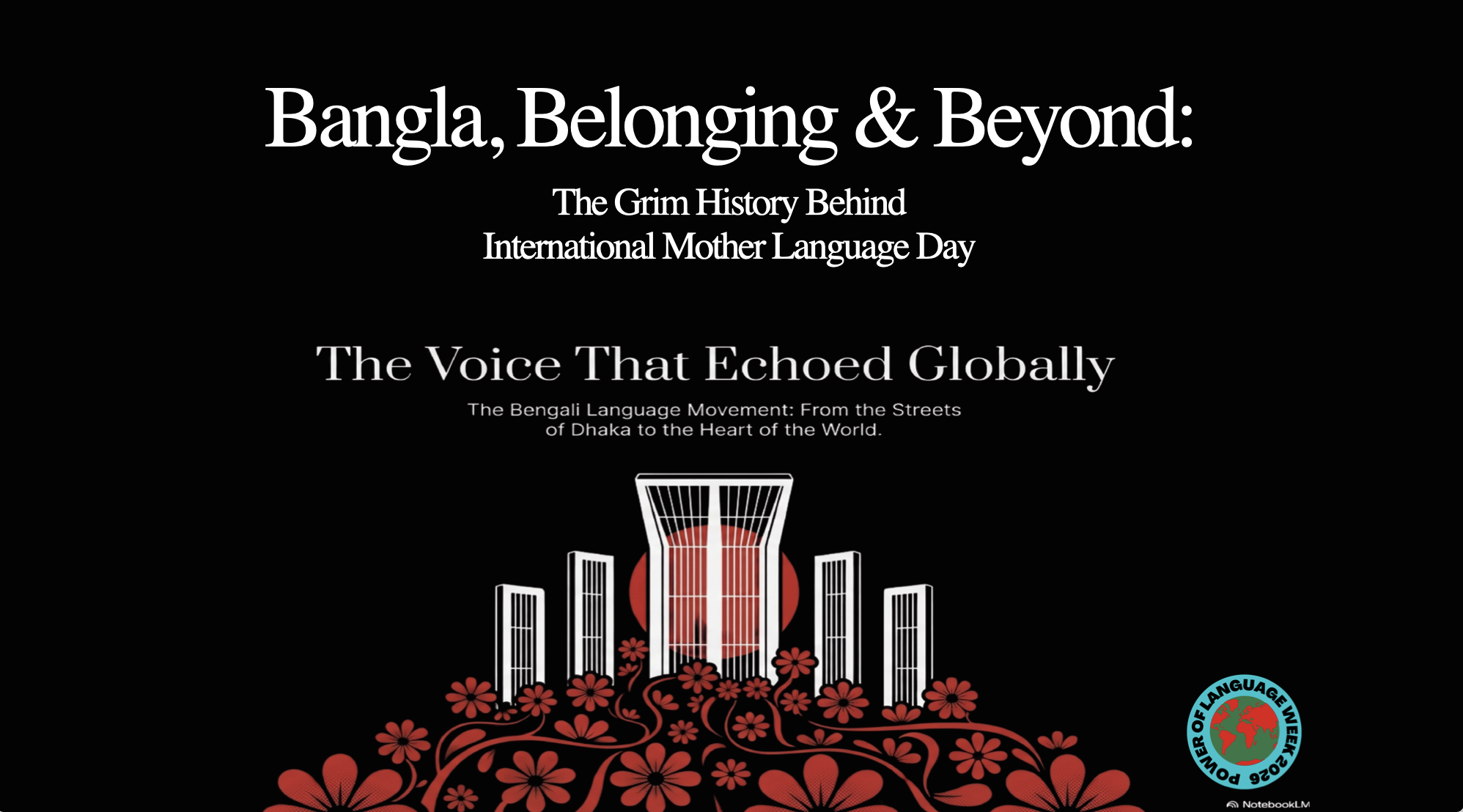
I attended an event titled Bangla, Belonging & Beyond during the Power of Language Week and took some field notes.
Sonaly Mehnaz stood in front of the room with an orange-patterned scarf elegantly draped around her neck. She stared intently at her laptop screen, slightly fidgeting with her trackpad. My eyes were immediately drawn to the intricate design of her earrings. They seemed so carefully crafted, and I could tell that they held some cultural significance. After one last glance at her laptop, she took a deep breath and stepped closer to the center of the room. Sonaly smiled warmly and politely nodded to people as they made their way into the room. Once enough people had made their way in, the organizers welcomed everyone to the event titled Bangla, Belonging & Beyond: The Grim Story Behind International Mother Language Day. It was co-hosted by the International Student Advisory Board and the Office of International Student Affairs.
Prior to this event, I had no knowledge about International Mother Language Day. Thankfully, Sonaly started the event with a very thorough rundown of how it came to be. She explained that the 1940s were a very dark time for Southern Asia. During the partition, the region was divided into three distinct countries: India, West Pakistan, and East Pakistan. These divisions were made by the British, India’s former colonial masters, on the basis of religion, and they did not account for ethnic and linguistic diversity. Bangladesh was formerly known as East Pakistan. There were about 44 million people in East Pakistan and about 25 million people in West Pakistan. Of the total population of both East and West Pakistan, 56.4% spoke Bangla and 3.37% spoke Urdu.
On the 21st of March in 1948, Muhammad Ali Jinnah, Pakistan’s first Governor General, instituted the “One Nation, One Language” policy. He declared that Urdu would be recognized as the state language of both East and West Pakistan. As expected, this policy infuriated many Bengalis. They felt like this was a direct attack on their linguistic heritage, and they were determined to do whatever was necessary to take a stand against this prejudiced law. After this policy was passed, a student called Abdul Matin publicly defied Muhammad Jinnah by speaking his language proudly in a public space. Infuriated by this act of defiance, the government, in 1952, ruled that students were not allowed to gather in large groups for fear of protests and civil unrest. However, in spite of this, students still gathered to take a firm stand, going out into the streets to protest.
Unfortunately, during this protest, the police shot and killed 6 students. This tragedy is now commemorated as Ekushey February, in which these 6 students are honored for their sacrifice and dedication to preserving their mother tongue. I took a pause from listening to her account to look around the room, and everyone was deeply engrossed in Sonaly’s story. Their eyes were fixed pointedly on her. I even noticed a few students who had gradually shifted toward the edge of their seats as she continued recounting these events with such passion. The events of the protest catalyzed subsequent movements, which ultimately led to Bangladesh’s independence.
This story was so moving to me because it highlights how central our indigenous languages are to our very being. In my group’s presentation on languages on Wednesday, I discussed how language is alive and evolving alongside society. The Bengali language, in this case, was born of the Bengali people and has continued to grow with them as an ethnic group. This makes it nearly inseparable from their cultural identities. Hence, to erase their language would mean erasing them as well. When a group of people is forced to repudiate their own cultural identity and adopt a foreign culture, we risk shifting their central reference point from everything they’ve known their whole lives to something completely unfamiliar. This creates the groundwork for psychological oppression because you are forced to reorient your central reference point, and it leaves you striving to adjust to something you were not meant to fit into because it is not your cultural identity. The Bengalis recognized this threat, and they fought to preserve their mother tongue. This is so honorable, and I wish my people had been able to do the same.